Originally posted on July 24, 2018.
Yes, that is right. Less than 2 weeks until Mike leaves to make the trip to Utah and still no engine. This is not to indicate that Mike Kopchik is not “on his game”. Actually it is just the opposite. He has been conferring with colleagues on the west coast to try and tune the fuel system appropriately for the conditions at Bonneville. As a result he had to take a step back and make modifications. He felt like he could be through last night so he and Mike are to talk this morning and (hopefully) we will be picking it up today.
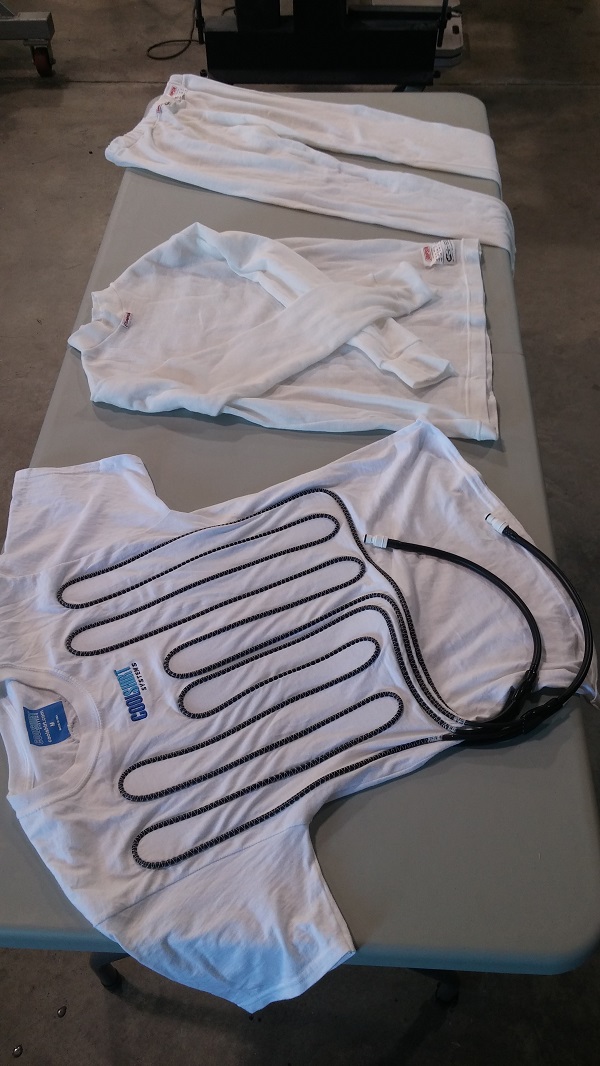
In the meantime I wanted to share some details on the wearable safety equipment. We have been accumulating these components for months now as they require a lot of research and are NOT inexpensive. Just like in other types of racing there are very strict rules on safety equipment. Every piece must be fire resistant and the end date on the tag must not be expired at the time used. For the Salt Flats in August we must be prepared for the heat that Mike will experience in the VERY HEAVY suit. We start with the undergarments. Mike will wear a CoolShirt with veins sewn in to be connected to a cold water tank in the car. One of my jobs will be to chill the water and fill and empty the water tank for each run. The fire retardant undergarments will go on top of the CoolShirt. I do not show them here but there will also be fire retardant socks.
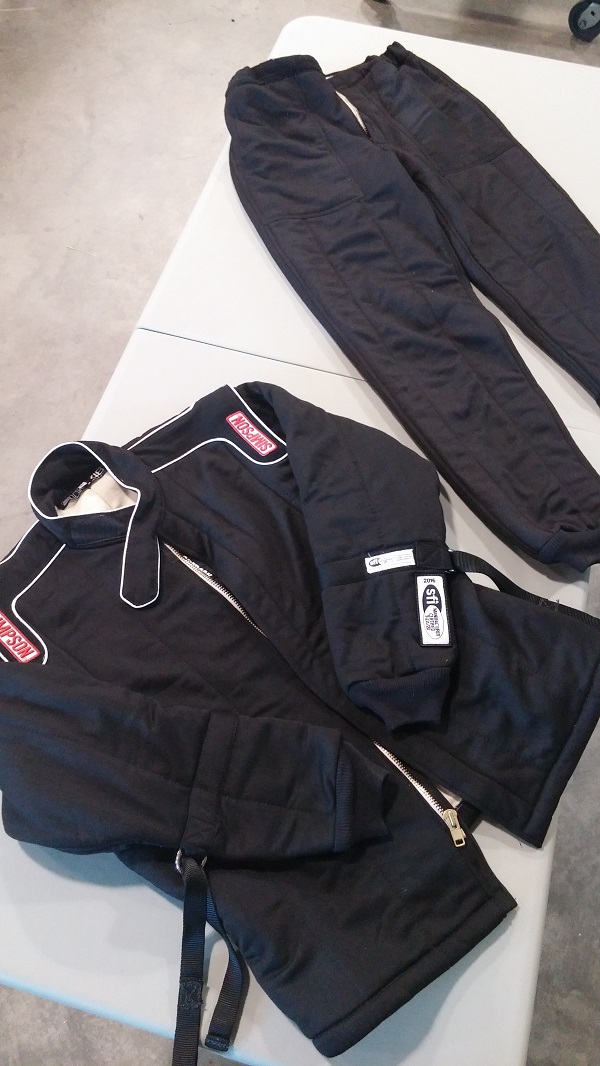
Next comes the driver’s suit. Of course it is fire retardant and it is heavy. I can certainly understand why he will need to have veins of cold water running underneath it to cool him. The weight of the suit and the fact that he will be in a completely enclosed capsule are both reasons for the CoolShirt system. Notice on the jacket that there are arm restraints. These hook into the seat belt to keep his arms inside the driver’s compartment in case of an emergency.
The rest of the safety gear is shown below. Shoes and gloves of course. Both fire retardant and both can only be used prior to the expiration date stamped on them. The helmet goes over the head sock shown at the lower right in the photo. The horseshoe-looking item is called a Haans device. It goes around Mike’s neck and the cord at the top hooks onto the helmet with some clips. The clips are connected to the red cords hanging off of either side of the helmet. Those are for Mike to be able to disconnect the helmet from the Haans device. That whole system is to protect the neck against injury. The other cords hanging off of the helmet are to connect to a radio system so we can communicate with Mike once he is in the car. Also notice the gold tube protruding from the lower front part of the helmet. That is to connect to an air supply that is cooled by ice.

FUN FACT: Mike, wearing all of this gear, is required to go through a timed drill on getting himself loose from the seatbelt system and out of the car before they will allow him to participate at the event. I am not sure how many seconds he has but that should be interesting to watch.
Now that I have explained all of that, who wants to take his place in the car? NOT ME! I will say I have been around this stuff long enough to understand that it is ALL in place for the “just in case of emergency” situation. I am thankful to be able to say we have never encountered a situation like that. The other thing Mike has helped me understand is that he is far safer in the car in an emergency than he (or anyone else) would be in an emergency situation in a passenger car riding down the interstate. It may surprise you but Mike does not speed and does not drive 80 or 85 on the interstate. He often comments on how people do not understand how one misstep may result in a terrible accident.
I will post again when we have the engine and things progress.
 Mike Welch Modifieds