Originally posted on July 30, 2018.
Okay. So we have the engine. Mike got it Friday afternoon. Here it is on the stand which is attached to the hoist in the shop. We were very nervous about whether it would fit in the engine compartment and whether the installation would require Mike to make modifications. No time for that now.
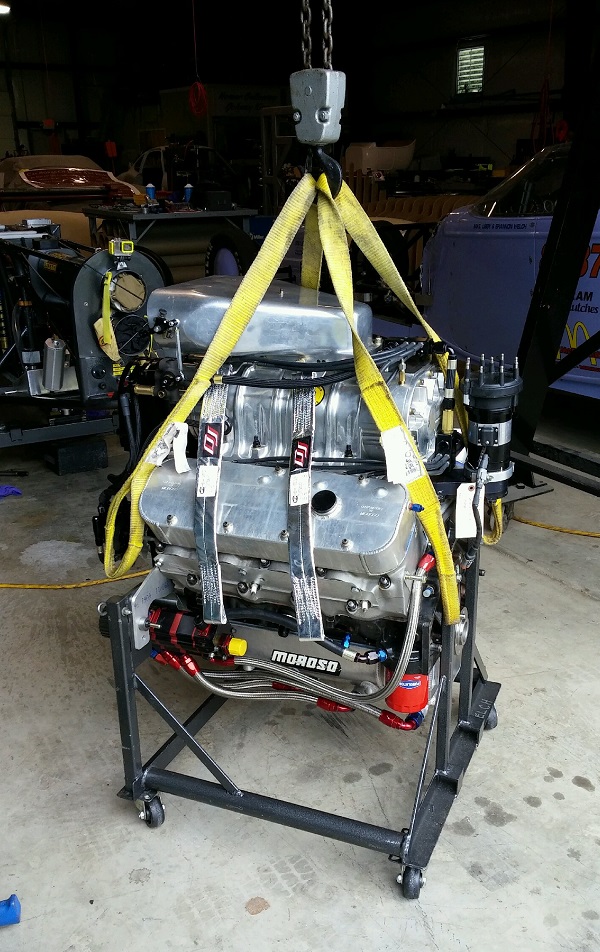
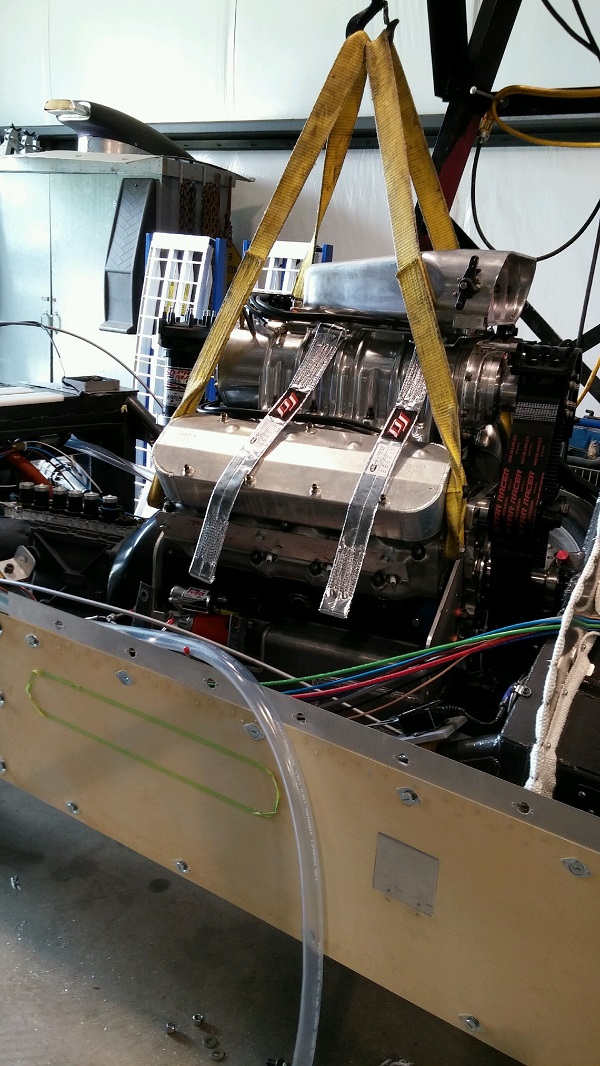
As you can see, here it is being lowered into the engine compartment. The bottom line is that it went in pretty smoothly. Mike only had to remove a couple of bolts to maneuver it into place. The silver straps are a safety requirement. They will hold down the blower should anything happen for it to lift off. Years ago we saw a drag car let loose a blower that landed in the grandstand and seriously hurt a spectator so we know it can happen.
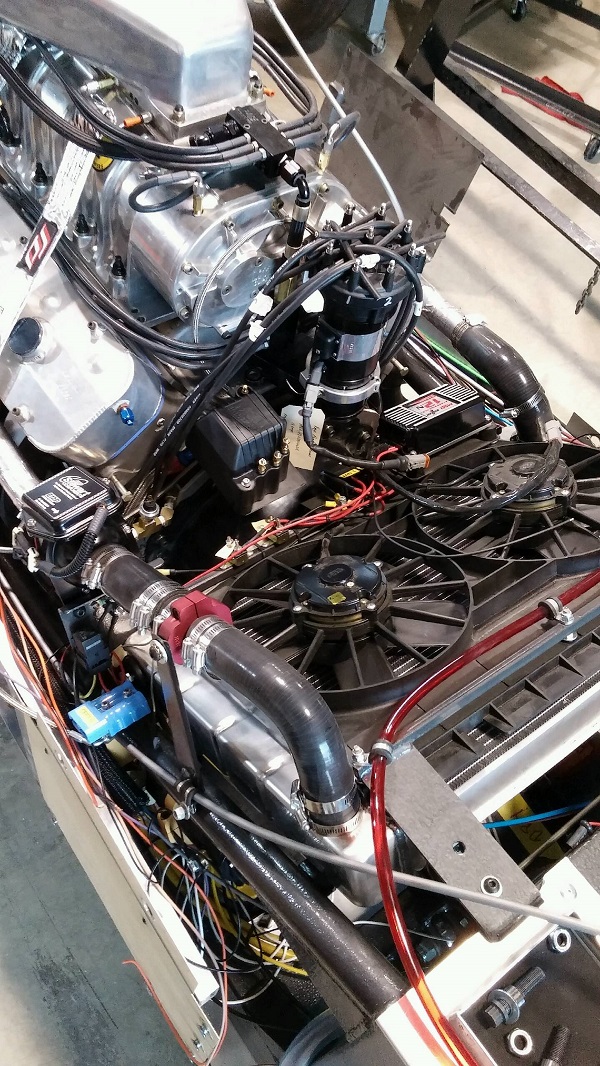
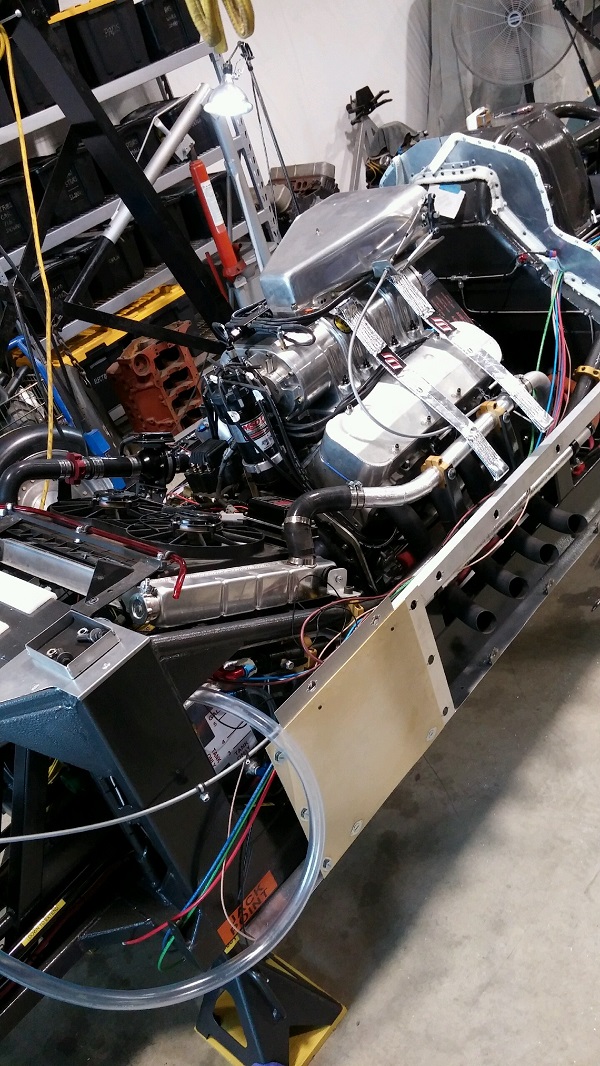
Mike hasn’t had time to share other details on the engine this weekend so perhaps that will come later. Meanwhile I will just let the next couple of photos speak for themselves.
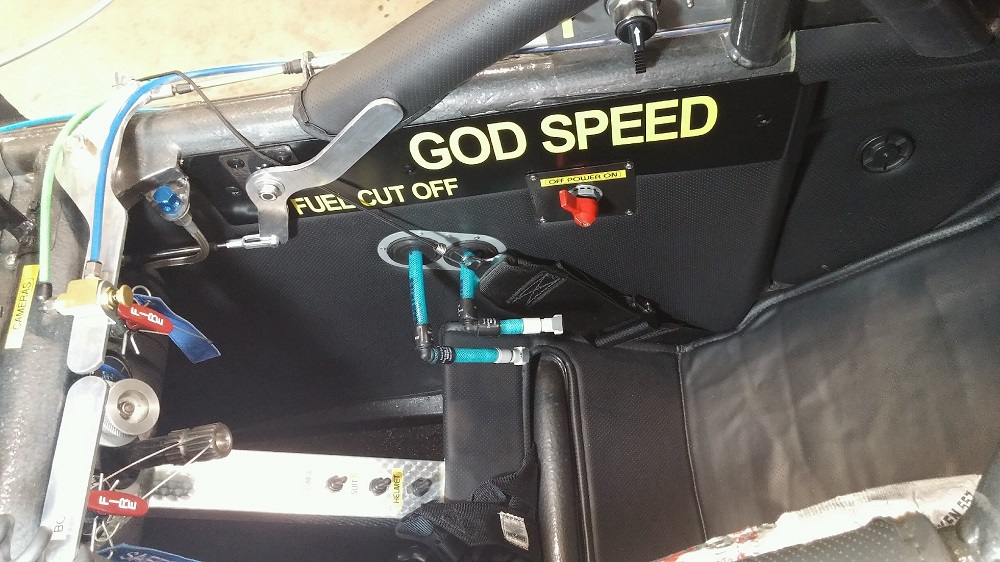
Here are some fun facts on life in the driver’s compartment:
– The removable steering wheel makes entry possible
– You can just barely see the panel in center of the wheel with the Off verbage to the right. This is the “kill” switch that actually cuts off the motor.
– The “kill” switch is activated only after the fuel supply is turned off. This is done with the lever at the driver’s right hand. It is above the FUEL verbage in the photo.
– Two silver handles above the red “T” FIRE knobs are the parachute releases. Two releases for two parachutes.
– The small brass button on the right parachute release is the shift button for the air shifted 4-speed transmission. The last shift is at over 200 mph.- The two red “T” handles are for the two fire extinguishing systems. One is for the engine and the other is for the driver’s compartment. Each has 10 pounds of chemical agent.
– The central silver knob allows the brakes to be adjusted front to back. This adjustment refers to how much loading each exerts in the braking process.
– The switch panel to the driver’s left shoulder controls electrical systems – 3 water pumps, 2 cooling fans and the ignition.
– The red switch to the driver’s right shoulder is a safety cut off for part of the electrical system.
– The silver hose to the left of the driver connects to the helmet and supplies chilled air.
– Two blue hoses to the right of the driver’s waist connect to the Cool Shirt and circulate chilled water around the driver’s back and chest.
– Street cars use a 3-point seat belt system. It is not seen in the photos but the system used here is a 13-point system. This includes two on the driver’s arms and four on the helmet.
– Space is at a premium. While somewhat comfortable once in position, entering is tough and exiting even more so. Once in position the driver cannot move.
– Gauges report engine speed, water, temperature and oil pressure. Three warning lights assist while the driver is otherwise focused at speed.
– The canopy is locked in place with a release over the driver’s head. An external release is (obviously) in place as well. When closed the compartment is no place for the claustrophobic.
– I have the job of getting Mike in and secured which takes a good 10 minutes.
– Communication from that point is by radio and/or message board.

What happens from here? Mike has spent the weekend getting the engine plumbed and wired. Unfortunately it has to come out for the installation of the clutch. We hope it will be ready late this afternoon. Also, the body has to be slightly modified for the engine to fit so Mike will be cutting out a couple of holes and refitting with a “bubble” to get that worked out. Mike Kopchik is to come over one evening to test out the fuel system and then the graphics go on the car another evening.
I’ll keep you posted.
 Mike Welch Modifieds